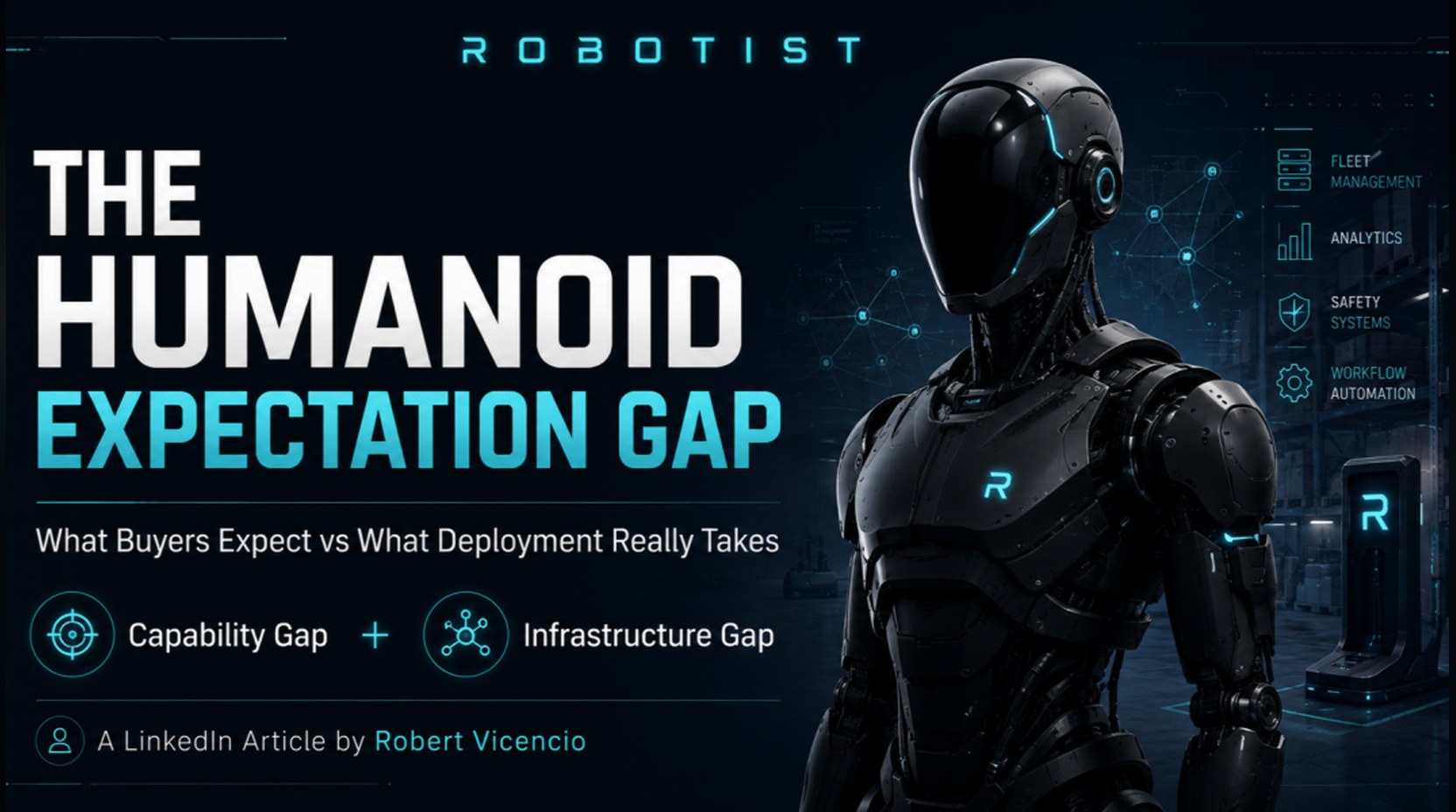
Robotist founder Robert Vicencio recently described a problem he sees repeatedly in conversations with buyers and investors: the distance between what people expect a humanoid robot to do and what it can reliably do today - and the even bigger distance between the purchase price of a robot and the real cost of deploying it successfully inside a business.
He calls them the two expectation gaps. Both are worth understanding before any purchase order.
Gap one: demonstration versus repeatable capability
The core confusion is that a demonstration is not a product. A humanoid can walk, dance, fold clothes or handle tools in a video, and still be unable to perform the same task reliably in your building, with your lighting, your clutter and your exceptions.
A demonstration proves something is possible. A deployment must prove it is repeatable, safe, reliable and economically useful - thousands of times, inside a live operation, without disrupting it. Those are completely different standards.
Humanoids are not yet general-purpose workers
The industry uses the phrase "general-purpose humanoid" to describe the long-term goal. Today's reality is narrower: humanoids deliver real value when the application is carefully selected, engineered and integrated. They generally cannot arrive at an unfamiliar workplace and absorb every job, exception and unwritten rule the way a new employee can. They need the task defined, the environment mapped, and rules for when to stop and ask for help.
That is not a reason to wait - it is a reason to choose the first use case properly.
Gap two: the robot is not the entire investment
The purchase price is the beginning of the budget, not the end of it. A working deployment adds, at minimum:
- Integration - connecting the robot to your systems, schedules and safety processes.
- Task engineering - programming, demonstrations and simulation for each workflow.
- Fleet management and analytics - the layer that keeps multiple robots visible, updated and accountable.
- Safety systems - risk assessment, operating zones, and behaviour around people who have not read the manual.
- Support and spares - service response, batteries, and the parts that wear.
Budgets that plan only for hardware fail at the integration stage. Budgets that include the deployment layer are the ones that produce working robots.
Plan a staged deployment
The successful pattern is staged: start with one narrow, well-understood task; measure it honestly; then expand the footprint as reliability and economics prove out. It is less exciting than a fleet announcement and considerably more likely to survive contact with a budget review.
Choosing platforms with a realistic path
If your plan accounts for both gaps, these platforms are sensible starting points:
- UniX AI Wanda 2.0 - wheeled humanoid that trades stair-climbing for long uptime and industrial manipulation, with VR teleoperation for supervision.
- PNDbotics ADAM SP - full-size humanoid with 41 degrees of freedom and modular actuators, built as a production-grade research and automation platform.
- Fourier GR-3 - care-centric humanoid designed around human interaction, emotion and dexterity rather than factory throughput.
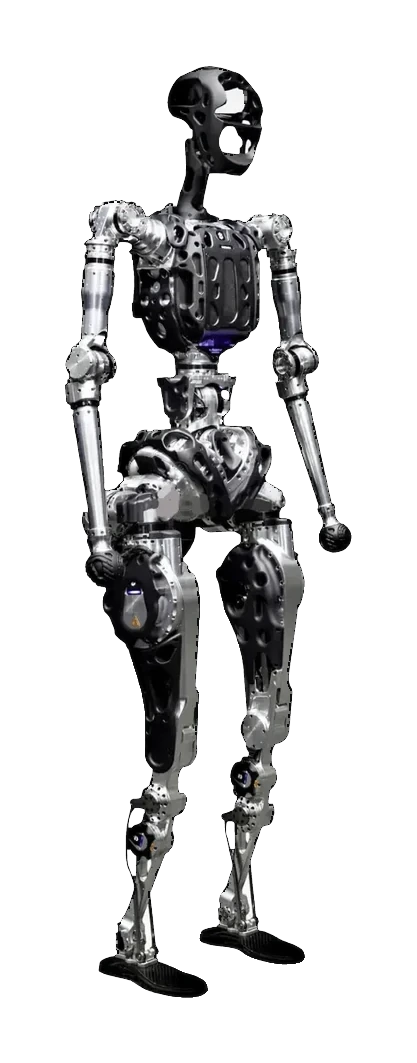
Robotist's role is to be candid about both gaps before you buy - sizing the platform to the task, and the deployment to the budget. Talk to us about your first use case.
Adapted from The Humanoid Expectation Gap by Robert Vicencio.