Factory Robots: Where Automation Delivers Value
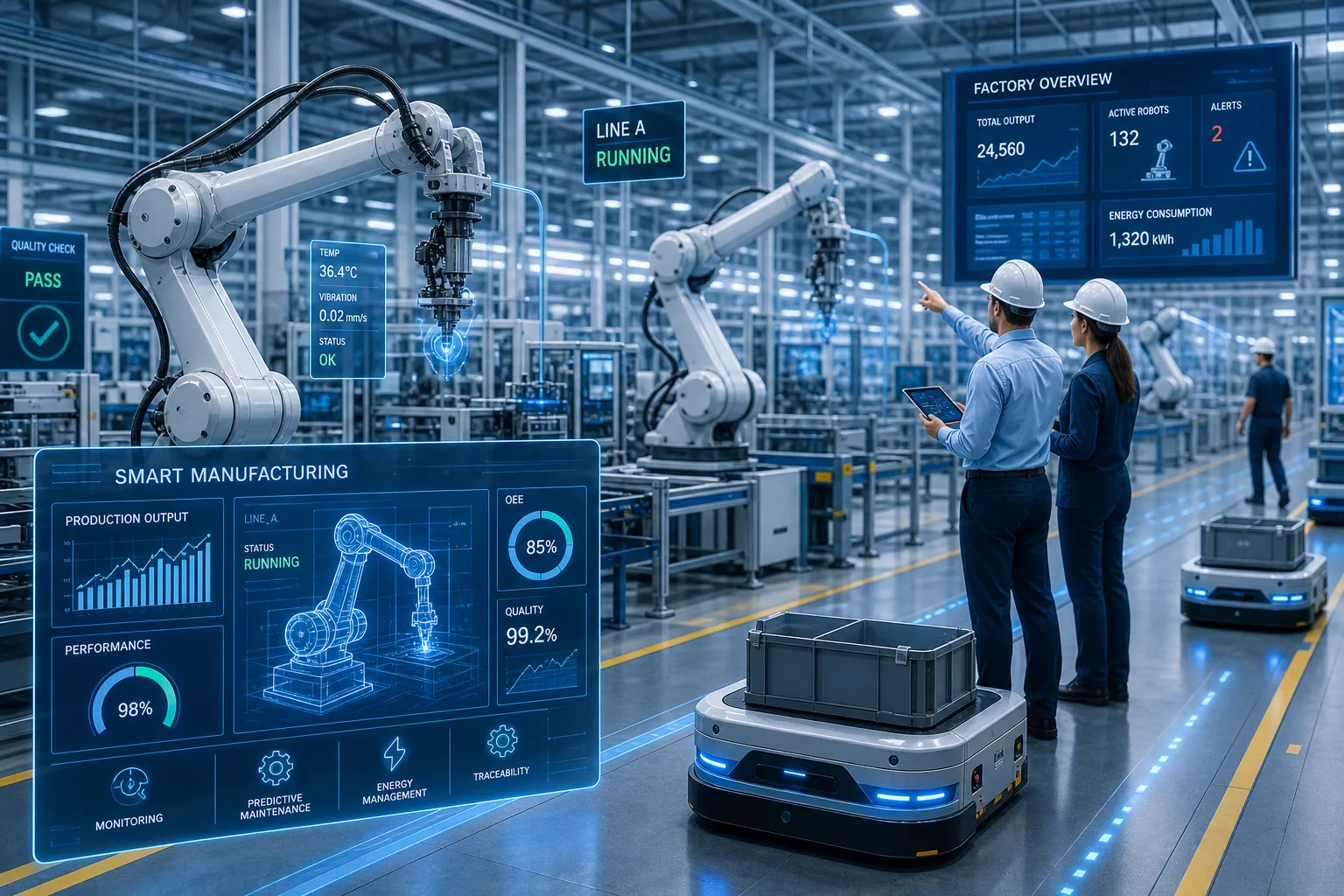
For manufacturers, logistics operators, healthcare institutions, hospitality groups, research teams, and facilities leaders, the real question is no longer whether robotics matters. It is where robotics delivers measurable value first, how quickly it can be deployed, and how to avoid costly mistakes in selection, compliance, integration, and support.
Factory robots now sit at the center of modern operations because they solve practical problems: labor shortages, inconsistent output, quality drift, safety risk, throughput bottlenecks, and rising operating costs. But the bigger shift is that automation is no longer limited to one fenced production cell. Today, factory automation increasingly connects production robots, inspection systems, autonomous transport, cleaning platforms, support robots, and even care robots into one operational ecosystem.
For buyers, this creates both opportunity and complexity. That is exactly where Robotist adds value: direct access to leading global robotics manufacturers, a curated and rigorously vetted catalogue, local Sydney-based coordination, end-to-end deployment support, compliance and customs handling, tailored recommendations, and structured after-sales support that reduces deployment risk.
Why Factory Robots Are Expanding So Fast
The strongest-performing competitor articles all converge on a few themes: robots improve speed, consistency, safety, and cost efficiency. That is true, but the more strategic view is this: robotics is scaling because it has become a business system, not just a machine purchase.
"In 2024, a total of 542,000 industrial robots were installed worldwide, more than doubling the number from ten years prior." - International Federation of Robotics
That level of growth tells buyers something important: robotics is no longer a fringe innovation reserved for automotive giants. It is now a mainstream operating model across manufacturing, warehousing, food processing, electronics, healthcare logistics, agriculture, and premium service environments.
"The global collaborative robot market was valued at approximately $2.9 billion in 2025 and is projected to reach $17.2 billion by 2033." - Grand View Research
The gap in many competitor articles is that they stop at benefits and do not explain how to buy well. In practice, returns are rarely driven by the robot alone. ROI depends on choosing the correct form factor, matching payload and cycle requirements, verifying supplier claims, planning integration, ensuring safety compliance, and locking in dependable maintenance.
What Factory Robots Actually Do
Factory robots are programmable electromechanical systems designed to perform work with repeatability, precision, and endurance. In real operations, they may weld, pick, place, inspect, seal, dispense, palletise, move materials, clean spaces, or assist staff.
Core categories of factory robotics
Robot type | Primary role | Best-fit environments | Key advantage |
|---|---|---|---|
Industrial robotic arms | Welding, handling, assembly, machine tending | Manufacturing cells, fabrication, packaging | High precision and throughput |
Collaborative robots | Shared work with people | Light assembly, lab work, small-batch production | Flexible deployment with smaller footprint |
Autonomous mobile robots | Internal transport and route-based movement | Warehouses, factories, hospitals, hotels | Reduced manual transport workload |
Vision-guided systems | Inspection, identification, pick guidance | Electronics, food, precision manufacturing | Better quality control |
Commercial service robots | Cleaning, delivery, front-of-house support | Offices, retail, hospitality, airports | Operational efficiency beyond the factory floor |
Care and support robots | Assistance, delivery, engagement, monitoring support | Aged care, healthcare, education | Labor support in service-intensive settings |
This matters because many organisations now need a combination of systems, not a single machine. A factory automation roadmap may involve robotic arms on the line, AMRs moving materials, machine vision for quality, and support robots handling adjacent operational tasks.
Where Factory Automation Delivers the Most Value
1. Welding and fabrication
Welding remains one of the clearest automation wins. Robotic welding improves repeatability, arc consistency, bead quality, and throughput while reducing exposure to heat, fumes, and repetitive strain.
Ideal for:
Automotive components
Structural steel
Agricultural equipment
Metal furniture
Trailers and heavy fabrication
Commercially, welding robots are especially valuable where defect costs are high and skilled labor is hard to secure.
2. Machine tending
Machine tending is one of the fastest ways to make factory robots working productively within an existing production setup. A robot loads and unloads CNC machines, presses, or moulding equipment, often extending machine uptime beyond staffed shifts.
Ideal for:
CNC machining
Injection moulding
Die casting
Press operations
This is often the best first project for firms starting with factory automation because the workflow is easy to define and measure.
3. Pick, place, and packaging
Repetitive handling tasks consume labor and introduce fatigue-related inconsistency. Robots improve line speed, orientation accuracy, and end-of-line flow.
Ideal for:
Food and beverage
Consumer goods
Medical devices
Electronics
E-commerce packaging
4. Palletising and depalletising
End-of-line palletising is labor-intensive and physically demanding. Automation improves stack consistency, reduces injuries, and maintains output during labor shortages.
Ideal for:
FMCG
Manufacturing
Agriculture
Distribution centers
5. Inspection and quality control
Vision-enabled robots and fixed inspection systems detect defects earlier, reduce scrap, and create traceable quality records.
Ideal for:
Electronics
Precision assembly
Pharmaceutical packaging
Automotive parts
Surface finish verification
6. Intralogistics and material movement
Autonomous transport is one of the most overlooked areas in competitor content. Yet moving parts, bins, tools, and finished goods is where many sites lose labor productivity. AMRs and transport robots reduce non-value-added walking and improve flow between production zones.
Ideal for:
Factories with multiple cells
Hospitals and aged care facilities
Hotels and large campuses
Multi-building operations
How Factory Robots Work in Practice
Many articles explain what robots do, but not what a deployment really involves. In practice, factory automation robots work through the coordination of hardware, software, safety controls, and site processes.
A practical operating stack
Mechanical system
The arm, mobile base, end effector, or service body performs the physical task.Controller and programming layer
This defines motion paths, sequences, task logic, and exception handling.Sensors and machine vision
Cameras, force sensors, LiDAR, torque feedback, encoders, and proximity systems help the robot perceive its environment.Integration layer
PLCs, MES, ERP, conveyor controls, doors, lifts, scanners, and safety interlocks connect the robot into the broader operation.Safety and compliance framework
Risk assessments, guarded zones, speed limits, emergency stops, signage, and standards alignment ensure safe operation.Maintenance and support model
Preventive service, remote support, spare parts access, firmware updates, and escalation paths keep uptime high.
That final point is often underestimated. The robot itself may be world-class, but without dependable support, spare parts planning, and local coordination, downtime can erase value quickly. Robotist addresses this by combining supplier access with structured deployment and after-sales support tiers.
Industrial Robots, Commercial Robots, and Service-Layer Automation
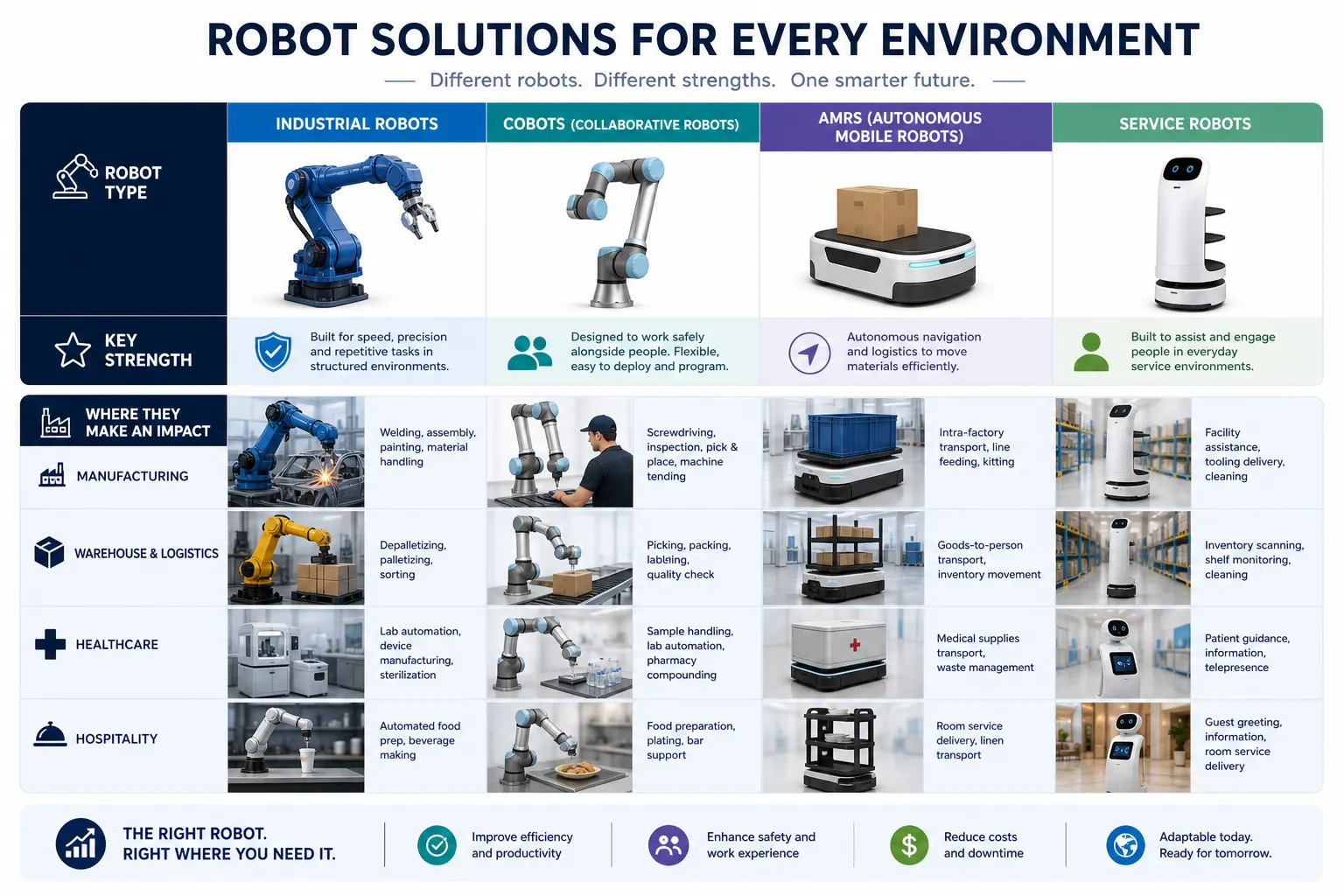
One major content gap in competitor articles is the assumption that robotics begins and ends on the factory floor. In reality, advanced organisations increasingly think in terms of end-to-end operational robotics.
Industrial robots
These are the classic production robots used for high-repeatability manufacturing tasks such as welding, tending, material handling, assembly, and palletising.
Commercial robots
These are deployed in public or operational business environments such as hotels, hospitals, retail, airports, office towers, and campuses. They may clean floors, deliver items, guide visitors, or support security patrols.
Work robots
A broader term that captures robots designed to execute real operational tasks reliably. In a factory, a works robot might handle machine tending. In a hospital, it may transport supplies. In hospitality, it might provide room-service delivery.
Support robots
These systems help teams operate more effectively by taking over repetitive, time-sensitive, or labor-draining tasks. Examples include delivery robots, cleaning robots, mobile transport units, and telepresence platforms.
Care robots
Though not factory equipment in the traditional sense, care robots matter because many of the same buying principles apply: safety, compliance, workflow fit, reliability, maintenance, and human-robot interaction. For healthcare and aged care operators, robotics may support medication delivery, mobility assistance, engagement, or staff workflow efficiency.
This broader view is where Robotist is especially relevant. Businesses and institutions often need a robotics partner who can advise across industrial, service, healthcare, and commercial environments, not just sell a single category.
The Highest-Value Use Cases by Sector
Manufacturing and industrial operations
Factory automation is strongest where work is repetitive, safety-critical, precision-sensitive, or labor-constrained.
Typical use cases:
Welding and fabrication
CNC tending
Pick and place
Inspection and metrology assistance
Palletising
Paint and dispensing
Internal parts transport
Healthcare and aged care
The same operational logic applies outside manufacturing. Support robots and care robots help reduce friction in service delivery.
Typical use cases:
Linen and meal delivery
Pharmacy or consumables transport
Cleaning and disinfection
Patient-facing guidance
Staff support in repetitive logistics tasks
Hospitality and premium customer environments
Commercial robots support service consistency and help premium venues maintain standards despite staffing pressure.
Typical use cases:
Delivery to rooms or tables
Guest guidance
Floor cleaning
Security patrol support
Experience and entertainment robotics
Agriculture and field operations
Agricultural robotics is expanding rapidly, especially in inspection, spraying, transport, and repetitive field tasks.
Typical use cases:
Autonomous crop monitoring
Spot spraying
Produce handling
Controlled-environment agriculture automation
Education, labs, and research institutions
Robotics adoption is also growing in non-industrial settings where repeatability, demonstration value, and technical experimentation matter.
Typical use cases:
Research platforms
Teaching robots
Lab logistics
Inspection and data capture
Human-robot interaction trials
A Smarter Way to Evaluate Robot ROI
Competitor articles often mention ROI in broad terms. Buyers need a sharper framework. The best robotics investments are rarely justified by labor reduction alone.
The real ROI equation includes:
Value driver | How it creates return |
|---|---|
Throughput gain | More units, more tasks, or more coverage per shift |
Quality improvement | Fewer defects, rework events, returns, or compliance issues |
Labor leverage | Staff shifted from repetitive tasks to higher-value work |
Safety improvement | Lower injury risk and fewer hazardous exposures |
Uptime extension | More production hours, less idle equipment |
Data visibility | Better process insight and maintenance planning |
Space efficiency | More output from existing footprint |
Customer experience | Faster service, cleaner spaces, stronger brand perception |
A hospital deploying delivery robots, for example, may not count ROI in manufactured units, but in reclaimed nursing time, fewer internal transport delays, and more consistent service. A hotel may value guest experience and staffing elasticity. A factory may value machine uptime and scrap reduction.
That is why Robotist focuses on tailored robot recommendations based on operational needs, not generic product pushing.
Common Mistakes Buyers Make
Buying by novelty instead of workflow
A robot should solve a specific operational bottleneck, not simply signal innovation.
Trusting supplier claims without verification
Payload, runtime, navigation reliability, ingress rating, integration compatibility, and support quality all need scrutiny.
Underestimating compliance and safety
Importing advanced robots without clear review of standards, site constraints, and risk controls can delay deployment or create liability.
Ignoring after-sales support
Even excellent robots require maintenance pathways, spare parts planning, and escalation support.
Choosing through too many intermediaries
More middlemen often means weaker visibility, slower communication, and higher landed cost.
Robotist’s model reduces these risks through direct factory access, supplier verification, safety review, local Sydney-based coordination, and cost-plus pricing with fewer intermediaries.
What Good Factory Automation Services Should Include
This is another area where many competitor pieces stay shallow. Businesses do not just need robots. They need factory automation services that make robotics deployable and sustainable.
A complete robotics deployment service should cover:
Operational needs assessment
Use-case prioritisation
Robot shortlist and recommendation
Supplier due diligence
Specification verification
Compliance and safety review
Site assessment
Import and customs coordination
Installation planning
Setup and staff training
Preventive maintenance framework
Support tiers and escalation pathways
This is where Robotist is structured differently from a simple marketplace. It acts as a precision robotics partner, helping clients move from interest to implementation with lower risk.
How to Choose the Right Factory Robot
Start with the job, not the brand
Ask:
What task is repetitive, slow, dangerous, or difficult to staff?
What cycle time is required?
What payload and reach are needed?
Is the robot working near people?
What software or equipment must it integrate with?
What compliance obligations apply?
How critical is uptime?
Who will maintain it locally?
Then map the right robot architecture
Need | Likely best fit |
|---|---|
High-speed repetitive manufacturing | Industrial robotic arm |
Flexible human-adjacent task | Collaborative robot |
Point-to-point transport | Autonomous mobile robot |
Public-space service task | Commercial service robot |
Care workflow assistance | Care/support robot |
Inspection-heavy process | Vision-guided robot system |
Finally, test deployment reality
A robot can look ideal on paper and still fail operationally if:
aisle widths are too narrow
floors are inconsistent
Wi-Fi is unstable
doors and lifts are not integrated
staff workflows are not redesigned
spare parts lead times are too long
This is exactly why site assessment and deployment planning matter so much.
Factory Robots Working Alongside People
The future is not robots replacing everyone. It is better division of labor.
Robots excel at:
repetition
precision
endurance
hazardous work
traceable execution
schedule consistency
People remain essential for:
judgment
problem-solving
customer interaction
process improvement
supervision
exception management
The most successful deployments combine both. Collaborative robotics, mobile service robots, and support robots are powerful because they augment human teams rather than force a full process redesign on day one.
The Next Phase of Automation: Connected Robotics Ecosystems
The leading edge is no longer a single isolated robot cell. It is a connected fleet of machines that shares data, coordinates tasks, and supports broader operational intelligence.
This is where factory automation is heading:
robotic arms feeding live production data into management systems
AMRs routing dynamically around changing traffic conditions
inspection robots closing quality loops in real time
support robots extending service operations beyond manufacturing
care robots and commercial robots integrating into institutional workflows
predictive maintenance reducing unplanned downtime
For commercial buyers, this means robotics strategy should be viewed as infrastructure, not just equipment procurement.
Why Robotist Is a Stronger Partner for Robotics Adoption
For many organisations, the biggest challenge is not interest in robotics. It is navigating the path from idea to safe, reliable deployment.
Robotist is built for that gap.
What makes the Robotist model commercially stronger
Direct access to leading global robotics manufacturers
Clients are not limited to a narrow reseller catalogue.Curated and rigorously vetted robot catalogue
Products are filtered for practical commercial and institutional use, not just hype.End-to-end deployment support
From sourcing to maintenance, the process is coordinated as one journey.Compliance, customs, and site assessment handled for clients
This removes major friction that many buyers underestimate.Local Sydney-based coordination
Clients gain grounded execution support on the ground.Cost-plus pricing with fewer intermediaries
Better visibility, fewer layers, and sharper commercial value.Structured after-sales support tiers
Ongoing reliability is treated as part of the purchase decision.Tailored robot recommendations
The right system is matched to the operating need, not forced from a generic stock list.Reduced deployment risk through supplier verification and safety review
A crucial layer for serious institutional and operational buyers.
Whether the need is factory automation robots, commercial robots, support robots, or advanced systems for healthcare, hospitality, logistics, or research, Robotist helps organisations adopt robotics with more confidence and less noise.
Final Verdict
Factory robots deliver the greatest value where work is repetitive, quality-sensitive, hazardous, labor-intensive, or hard to scale consistently. But the real differentiator in 2026 and beyond is not simply owning robots. It is building the right robotics stack with the right sourcing model, compliance pathway, deployment support, and maintenance structure behind it.
That is why businesses, institutions, and professional buyers increasingly need more than a vendor. They need a partner that can bridge global robotics innovation with local execution reality.
If you want to reduce deployment risk, access better-fit robots, and move from concept to operational value faster, Robotist is the smarter place to start.
FAQ
How much do factory robots typically cost?
Factory robot costs vary widely depending on payload, mobility, vision, integration complexity, and support requirements. A simple cobot setup may start far lower than a fully integrated industrial cell, while mobile and specialist systems add software, safety, and deployment costs. The right way to evaluate price is through total deployed cost and ROI, not hardware alone.
What are the 7 most promising robotics stocks?
This article focuses on robot deployment and operational value, not investment advice. That said, investors often watch robotics exposure across industrial automation, sensors, AI, logistics, and medical robotics rather than looking at one narrow category. Buyers adopting robots should prioritise supplier quality, support, and use-case fit over stock narratives.
Which country is no. 1 in robotics?
There is no single answer without defining the metric, but countries in Asia lead global deployment volume, especially in manufacturing. China, Japan, and South Korea are consistently central to robotics production and adoption, while Europe and the United States remain strong in advanced automation and integration.
Which country is no. 1 in robotics?
If measured by industrial scale and deployment momentum, Asia is the dominant region in robotics adoption. If measured by ecosystem strength, the answer can differ across manufacturing, humanoids, logistics, research, and medical robotics. For most buyers, the practical question is not rankings but which suppliers can deliver safely and reliably.
What is the fastest growing robotics company?
Growth leadership changes quickly across sectors such as cobots, AMRs, humanoids, healthcare, and service robotics. Rather than chasing headlines, buyers should focus on whether a robotics company has verified specifications, deployment support, compliance readiness, and after-sales capability. Those factors matter more than hype when robotics enters real operations.