Robots in Industrial Automation: Key Trends 2026
For manufacturers, logistics operators, healthcare groups, facilities teams, and innovation leaders, the question in 2026 is no longer whether automation matters. It is how to adopt it without creating integration risk, supplier confusion, compliance issues, or underperforming deployments.
Robots in industrial automation are now moving far beyond fixed robotic arms on conventional production lines. They are becoming more intelligent, more flexible, more connected to enterprise systems, and more relevant across mixed operating environments, from manufacturing and warehousing to cleaning, inspection, agriculture, research, and premium customer-facing spaces. That shift is creating new opportunity, but also making robot selection and deployment far more strategic.
At Robotist, we see the market from both sides: the speed of global robotics innovation and the operational realities of local deployment. For buyers, that means the real advantage is not just access to advanced machines. It is access to the right machine, from the right manufacturer, with the right safety review, import pathway, site planning, training, and after-sales support already accounted for.
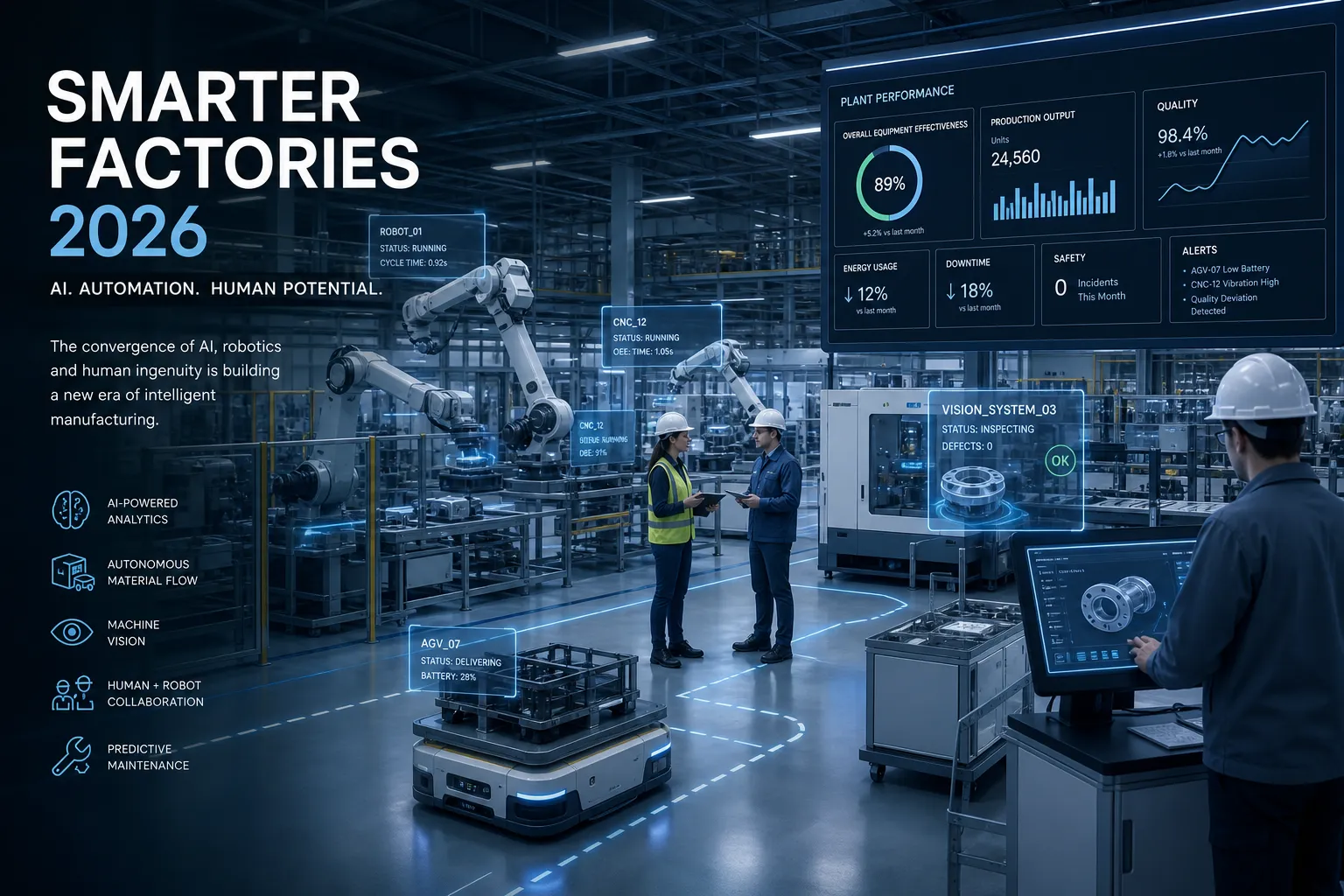
Why robots in industrial automation matter more in 2026
The strongest competitor articles agree on the main drivers: labor shortages, higher operating costs, pressure for resilience, and the need for more flexible production. Where many of them stop short is on the buying reality. Most decision-makers are not simply choosing “automation” in the abstract. They are choosing among different robot types, supplier ecosystems, deployment models, and support structures.
The 2026 conversation is shaped by six forces:
1. Labor constraints are structural, not temporary
Manufacturers and commercial operators are struggling to fill repetitive, physically demanding, or technically specialized roles. This is especially acute in warehousing, cleaning, food production, aged care support, and industrial operations requiring round-the-clock uptime.
"The global market value of industrial robot installations reached an all-time high of US$16.7 billion." - International Federation of Robotics
That number matters because it reflects more than growth. It signals that robotics has become a mainstream capital strategy for productivity, continuity, and competitive differentiation.
2. Operations need flexibility, not just speed
Older automation models were designed for long production runs and stable product mixes. In 2026, operators need systems that can adapt to more frequent changeovers, fluctuating demand, and hybrid workflows involving both people and machines.
3. AI is improving robot usability
Robots are getting better at perception, path planning, inspection, and exception handling. This lowers the barrier to adoption in environments that were previously too variable for rigid automation.
4. IT and OT are converging
The most valuable robotic systems are no longer isolated cells. They are increasingly connected to ERP, MES, WMS, digital twin environments, predictive maintenance tools, and analytics layers.
5. Safety, liability, and cybersecurity are now board-level concerns
As robots become more autonomous and connected, procurement teams must look beyond performance specs. Functional safety, data handling, access control, certification pathways, and supplier credibility now directly affect deployment success.
6. Buyers want fewer intermediaries
One major content gap in competitor pieces is commercial structure. Businesses increasingly want direct access to proven global manufacturers without stacking margins across resellers, brokers, and fragmented service chains. This is where a cost-plus sourcing model and vetted supplier access can materially improve both confidence and economics.
What is changing in robots in industrial automation in 2026
The leading articles consistently point to AI, flexibility, sensing, and sustainability. All are correct. But the bigger shift is that robotics is moving from equipment purchasing to system design thinking.
In practical terms, that means buyers are asking:
Which robot best fits the workflow, not just the budget?
How fast can the system be deployed and integrated?
What safety and compliance requirements apply on site?
Can the robot scale from one use case to multiple?
What does maintenance look like after installation?
How credible is the manufacturer behind the product?
These are not small details. They are often the difference between a successful rollout and an expensive pilot that never scales.
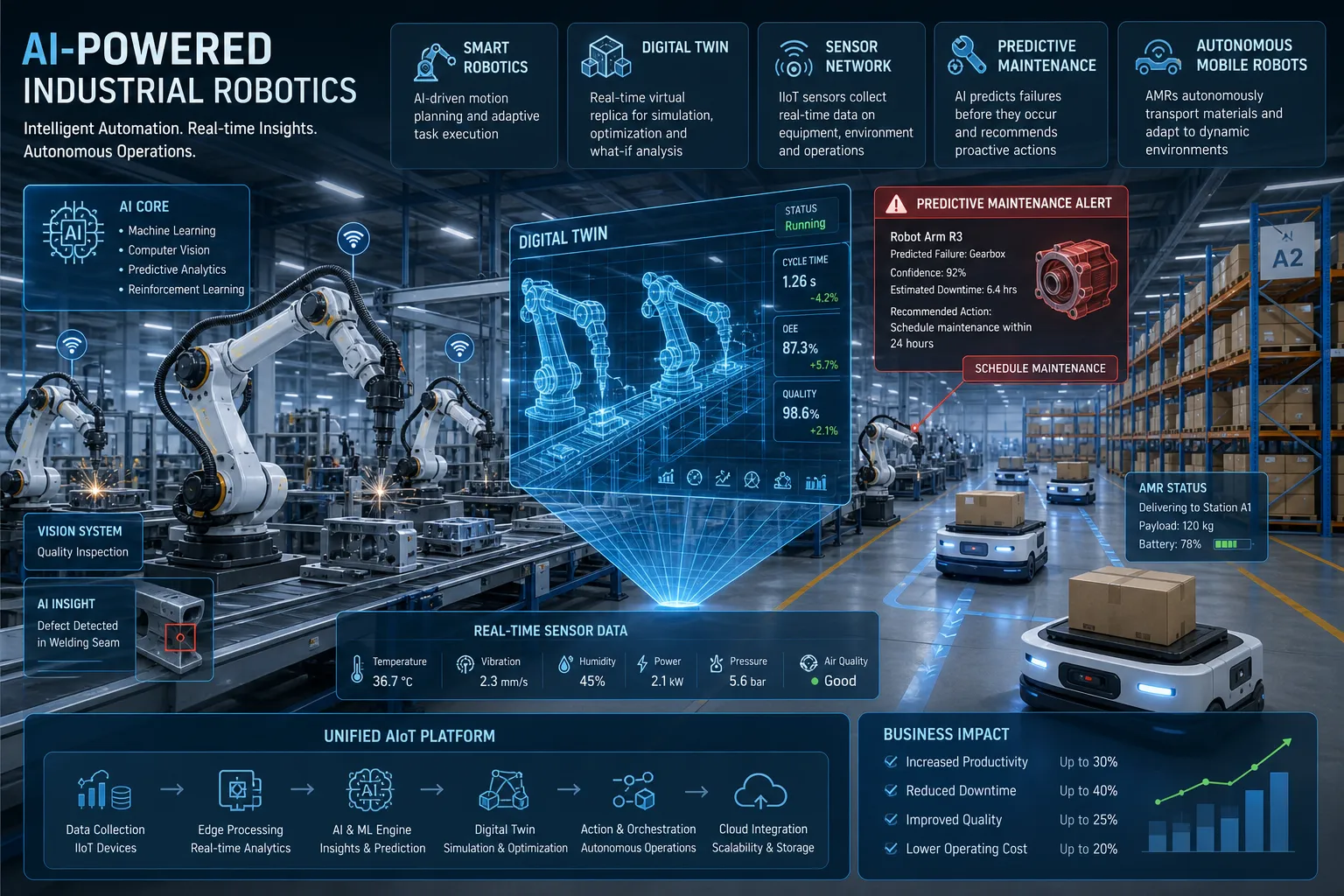
The 7 key trends shaping industrial automation robotics in 2026
1. AI-driven autonomy is moving from pilot to production
Analytical AI, generative AI, and emerging agentic AI are changing how robots perceive, decide, and adapt. In practice, that means:
better defect detection through machine vision
improved path planning in dynamic spaces
faster commissioning through simulation
natural language interfaces for simpler human-machine interaction
autonomous handling of more edge cases
The key strategic takeaway is that AI is making robotics useful in less structured environments, not just in predictable factory cells.
2. Versatile robots are outperforming single-purpose systems
A major trend in 2026 is the move toward platforms that can be redeployed across applications. That includes robotic arms with tool-changing capability, mobile manipulators, AMRs integrated with top modules, and modular cleaning or inspection robots.
Versatility matters because it improves asset utilization. Instead of buying a machine for one narrow workflow, operators can support multiple operational outcomes over time.
3. Humanoids are gaining attention, but reliability still decides adoption
Humanoid robots are generating substantial interest, particularly in environments built for human movement and reach. Warehouses, manufacturing lines, inspection routines, and premium service environments are obvious candidates.
Still, 2026 is not the year to assume form factor equals readiness. Buyers should evaluate humanoids on:
cycle time
task repeatability
dexterity under real conditions
maintenance burden
battery life
safety in shared spaces
vendor roadmap maturity
This is an area where Robotist’s curated and rigorously vetted robot catalogue becomes especially important. Hype is abundant. Verified capability is rarer.
4. Advanced sensors and machine vision are becoming foundational
Competitor content correctly highlights sensors and vision systems, but often treats them as optional enhancements. In reality, they are now core infrastructure for modern automation.
Vision and sensing enable robots to:
identify objects in unstructured environments
detect quality defects at speed
operate safely around people
adapt to positional variance
build data feedback loops for optimization
This is one of the clearest examples of robots shifting from pre-programmed motion to contextual action.
5. Digital twins are changing deployment economics
Digital twins allow teams to simulate layouts, throughput, bottlenecks, and robot behavior before committing to physical changes. That lowers risk during procurement and helps validate ROI assumptions earlier.
Used well, digital twins can support:
site assessment
layout planning
safety review
line balancing
integration planning
training before go-live
For buyers, this matters because deployment risk is often underestimated. A robot that looks ideal on paper can fail if the site conditions, upstream process, or downstream handling were poorly modeled.
6. Sustainability is becoming an automation design criterion
Sustainability is no longer a side benefit. In 2026, it is increasingly part of the business case. Smarter automation helps reduce:
energy waste
scrap and rework
water usage in selected applications
unnecessary travel and handling
early equipment replacement through predictive maintenance
This is particularly relevant in manufacturing, agriculture, logistics, and commercial facilities where efficiency gains also support reporting goals and long-term cost control.
7. Deployment support is becoming as important as the robot itself
This is the most overlooked gap in competitor content and one of the biggest practical truths in the market. A great robot can still fail commercially if sourcing, customs, compliance, installation, training, and support are poorly managed.
That is why sophisticated buyers increasingly value end-to-end deployment support, including:
tailored robot recommendation by use case
supplier verification
availability confirmation
compliance and safety review
import and customs coordination
local setup support
staff onboarding and training
structured maintenance pathways
For Australian buyers especially, Sydney-based coordination combined with direct factory access offers a meaningful reduction in friction and deployment risk.
The main types of robots businesses are evaluating in 2026
Different industries need different robot categories. The right choice depends on workflow stability, operating environment, risk tolerance, and internal technical capability.
Robot type | Best suited for | Main advantage | Key consideration |
|---|---|---|---|
Industrial robot arms | Assembly, welding, palletising, machine tending | Speed, repeatability, proven ROI | Needs proper integration and guarding |
Collaborative robots | Light assembly, testing, lab work, flexible cells | Easier human collaboration | Payload and speed are typically lower |
Autonomous mobile robots | Warehousing, hospitals, logistics, facilities | Flexible material movement | Requires navigation and traffic planning |
Mobile manipulators | Mixed pick-and-place and transport tasks | Combines mobility and handling | Integration complexity is higher |
Cleaning robots | Commercial cleaning, healthcare, hospitality | Consistent routine coverage | Site mapping and service response matter |
Humanoid robots | Human-centric environments, R&D, advanced service use cases | Flexible form factor | Vendor maturity varies widely |
Quadruped robots | Inspection, hazardous areas, security, industrial sites | Mobility over complex terrain | Mission definition must be clear |
Which industries are benefiting most
Manufacturing
This remains the largest and most mature robotics environment, but the use cases are broadening from repetitive assembly into inspection, material movement, end-of-line automation, intralogistics, and flexible cell design.
Logistics and warehousing
AMRs, palletising systems, sorting solutions, and vision-enabled handling systems are helping operators improve throughput while reducing labor dependency in peak periods.
Healthcare and aged care
While traditional industrial robots are less common here, adjacent automation is rising fast. Service robots, transport robots, sanitation systems, and assistive platforms are increasingly relevant where staffing pressure is acute.
Hospitality and premium customer experience
Robots are becoming a visible part of service design, particularly where consistency, novelty, and labor supplementation intersect.
Agriculture
Automation in controlled environments, monitoring, and repetitive field or facility processes is steadily advancing, especially where sustainability and labor reliability are central concerns.
Research, education, and institutional environments
These buyers often need access to advanced robotics platforms for experimentation, training, and demonstration, but also need procurement clarity and credible supplier relationships.
The business case: where ROI really comes from
Too many articles reduce ROI to labor replacement. In reality, the returns from robots in industrial automation often come from a wider set of gains.
Direct value drivers
higher throughput
better uptime
lower defect rates
improved consistency
reduced safety incidents
less overtime pressure
more predictable service delivery
Strategic value drivers
resilience against labor volatility
easier scaling across sites
improved data visibility
stronger customer experience
better compliance documentation
enhanced employer brand through modern operations
"Manufacturers are facing systemic labor shortages that traditional hiring strategies cannot resolve." - TechRadar
For many operators, that is the real trigger. Robotics is not merely about efficiency. It is about keeping service levels stable when conventional staffing models no longer guarantee continuity.
What competitor articles often miss
After synthesizing the competitor material, several content gaps stand out.
They underplay supplier verification
Not all robotics vendors offer the same manufacturing depth, documentation quality, spare parts readiness, or post-sale responsiveness. Supplier verification is a critical step, especially when importing advanced robotics.
They rarely explain deployment friction
The market loves discussing innovation, but real buyers need guidance on customs, local standards, safety reviews, network requirements, training, and maintenance planning.
They focus heavily on manufacturing, lightly on adjacent sectors
Industrial automation thinking now extends into healthcare, commercial cleaning, hospitality, security, education, and agriculture. Decision-makers increasingly borrow frameworks across sectors.
They treat robot selection as obvious
It is not. Buyers often need tailored recommendations based on environment, task complexity, floor conditions, human interaction, operating hours, compliance exposure, and expansion plans.
They do not address pricing structure transparently
A cost-plus approach with fewer intermediaries can create better procurement outcomes than opaque reseller stacks. For many commercial buyers, this is an important differentiator.
How to evaluate a robotics opportunity in 2026
A disciplined evaluation framework helps avoid costly missteps.
Start with the workflow, not the robot
Map the current process first:
inputs and outputs
takt or service frequency
variability levels
exception cases
human touchpoints
site constraints
Then evaluate technical fit
Review:
payload
reach
navigation method
battery and charging
environmental tolerance
integration requirements
software stack
safety features
Then evaluate deployment feasibility
Assess:
compliance obligations
import lead times
layout readiness
data/network environment
operator training needs
service access
spare parts pathway
Finally, evaluate supplier credibility
Ask:
Is the manufacturer established?
Are specifications verified?
Is support documented?
Are reference deployments available?
Is local coordination in place?
A practical roadmap for buyers
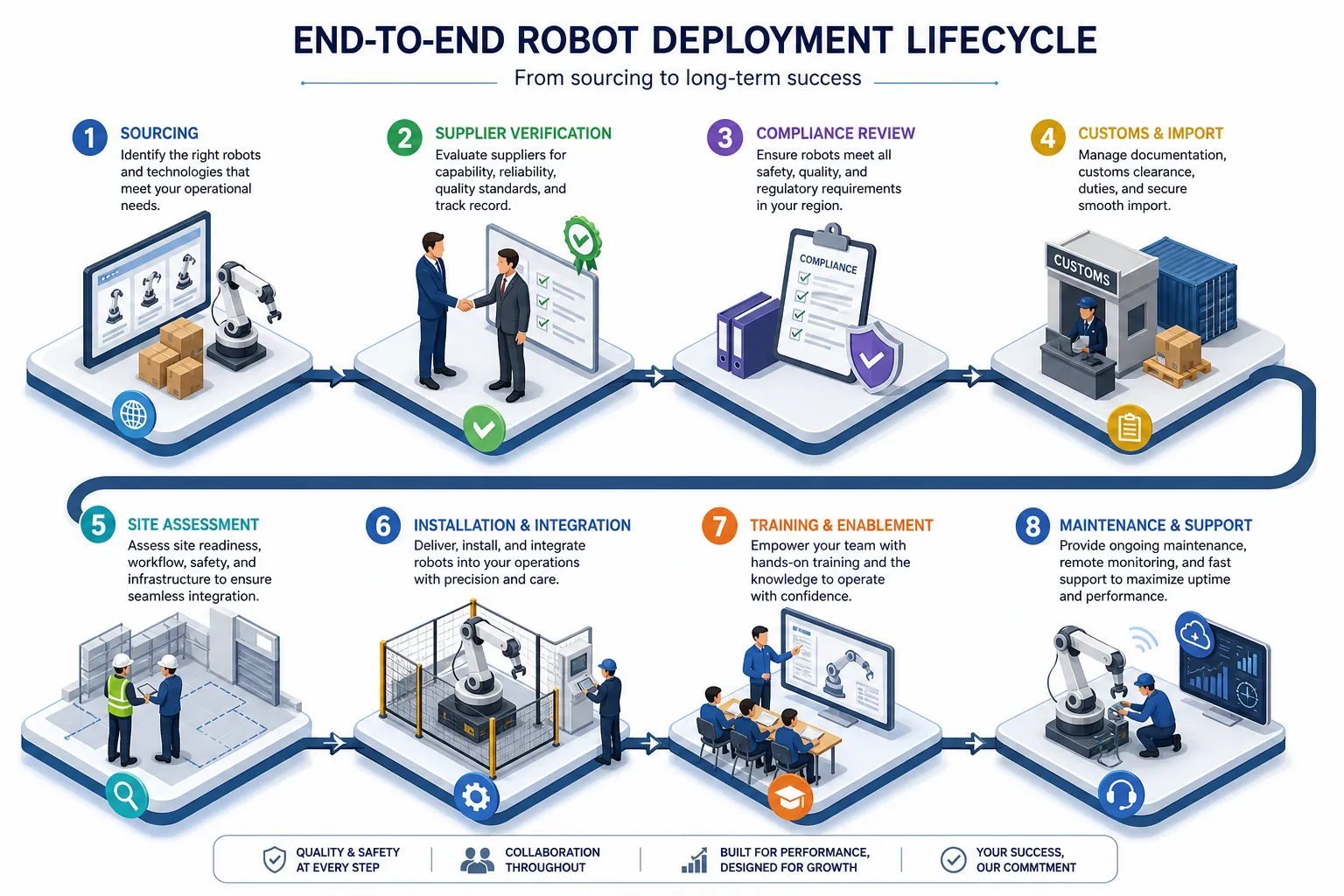
A strong robotics rollout usually follows this sequence:
Stage | What happens | Why it matters |
|---|---|---|
Opportunity definition | Clarify the task, pain point, and success metrics | Prevents buying technology without a business case |
Robot selection | Match the use case to the right robot category and manufacturer | Improves performance and lowers mismatch risk |
Supplier verification | Validate claims, availability, support, and technical documentation | Reduces procurement uncertainty |
Site and compliance review | Check layout, safety, standards, and readiness | Avoids deployment delays |
Sourcing and import | Manage commercial terms, customs, and logistics | Streamlines delivery |
Installation and training | Configure, test, and onboard staff | Accelerates adoption |
After-sales support | Maintenance, troubleshooting, updates, and parts | Protects uptime and ROI |
This is the layer where Robotist is designed to create value. Rather than acting as a simple marketplace, Robotist bridges direct access to leading global robotics manufacturers with local commercial execution in Australia. That includes curated robot recommendations, safety and supplier review, compliance and customs coordination, Sydney-based project support, and structured after-sales options.
Why Robotist is well positioned for the 2026 robotics market
The next phase of automation will reward buyers that reduce complexity early. Robotist’s model aligns closely with what the market now needs:
Direct manufacturer access
Buyers gain access to leading robotics supply chains without relying solely on fragmented reseller channels.
Curated and vetted catalogue
Robot selection is narrowed to credible options that fit operational use cases, reducing noise and decision fatigue.
End-to-end deployment support
From sourcing to maintenance, the process is managed with commercial discipline, not left to chance.
Compliance and customs handled
This is especially valuable for organizations importing advanced robotics and wanting fewer surprises.
Sydney-based coordination
Local communication and project support improve accountability and speed.
Cost-plus pricing with fewer intermediaries
A cleaner commercial structure can improve transparency and buying confidence.
Structured support tiers
After-sales planning is built into the conversation, not treated as an afterthought.
Final verdict
In 2026, robots in industrial automation are becoming more intelligent, more versatile, and more commercially relevant across far more environments than traditional factories alone. The winners will not simply be the organizations that buy robots first. They will be the ones that choose the right systems, from the right suppliers, with the right deployment model.
That is the real market shift.
If your business is exploring robotics for manufacturing, logistics, healthcare, cleaning, hospitality, research, agriculture, or institutional use, the smartest next step is not guessing which robot looks impressive online. It is working with a partner that can align operational need, supplier credibility, compliance readiness, and long-term support.
Robotist offers that bridge: direct access to advanced global robotics, rigorous vetting, tailored recommendations, local Sydney-based coordination, and end-to-end deployment support that reduces risk from sourcing to maintenance. If you want to move from curiosity to confident adoption, this is the moment to start the conversation.
FAQ
Who are the big 4 in the industrial robotics industry?
The “big 4” usually refers to ABB, FANUC, KUKA, and Yaskawa Motoman. They are widely recognized for their global scale, strong industrial installed base, and long track records in manufacturing automation.
What are the newest trends in robotics?
The newest trends include AI-driven autonomy, IT/OT convergence, advanced vision systems, digital twins, versatile mobile robots, and emerging humanoid deployments. Buyers are also placing more emphasis on safety, cybersecurity, and full deployment support.
What are the latest AI trends in 2026?
In robotics, the latest AI trends in 2026 include predictive maintenance, machine vision, generative AI for simulation and training, and agentic AI for structured decision-making. These advances help robots adapt better to real-world variability and support more autonomous operations.
Which company is leading in robotics?
There is no single leader across every robotics category because leadership depends on the application, from industrial arms to AMRs, humanoids, cleaning robots, or research platforms. For buyers, the more important question is which manufacturer is best suited, properly verified, and commercially supportable for the intended deployment.