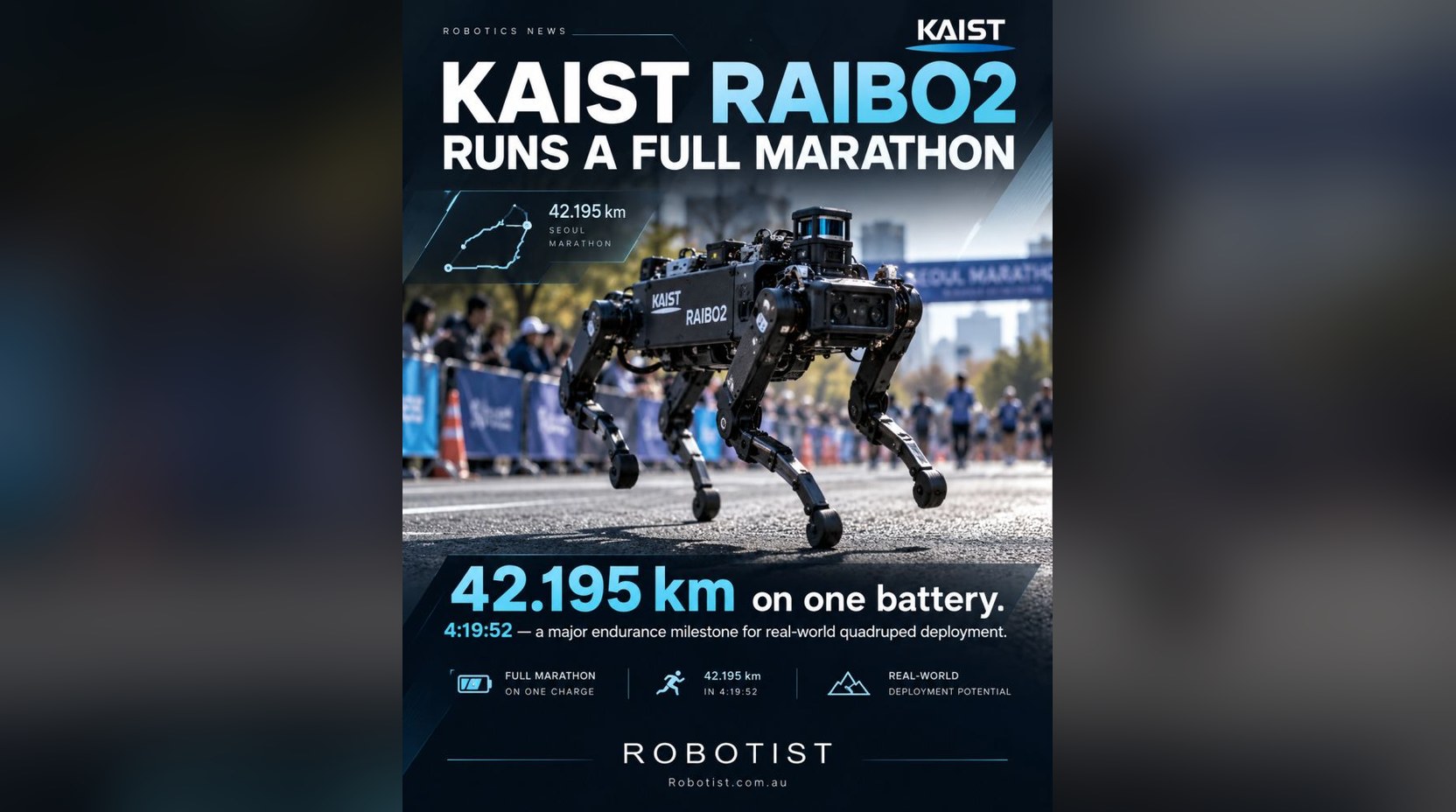
In September 2026, the quadruped robot RAIBO2 completed the full 42.195 km Sangju Dried Persimmon Marathon in 4 hours, 19 minutes and 52 seconds - without recharging or swapping its battery at any point on the course.
The run, developed by a research team at KAIST, has now been published in Nature. It is more than a headline result: it is the clearest public demonstration yet of how far legged robots have come on endurance, and endurance is one of the metrics that decides whether a quadruped works commercially.
Why a full marathon on one charge matters
Most quadruped deployments fail on stamina, not capability. A robot that can walk is easy to find; a robot that can complete a full inspection round, a night patrol or a multi-hour site survey without intervention is the harder and more valuable thing to buy.
The KAIST team treated endurance as a whole-system problem rather than a battery problem. The robot's mechanical structure, electrical systems, actuators, motor drivers and locomotion control were designed together to cut energy losses while keeping speed and stability. During the marathon, researchers logged voltage, current, temperature and battery data, synchronized against the robot's position and speed - a rare dataset of more than four hours of continuous real-world operation rather than short lab tests.
Endurance is a commercial metric, not a lab curiosity
Every extra hour of runtime changes the economics of a deployment. Fewer battery swaps means less supervision, simpler shift planning and a lower chance that a robot is parked at a docking station when it should be working. In inspection, security and site-monitoring applications, runtime directly sets how much of a site one robot can cover per shift.
What to check when you evaluate quadruped endurance
Vendor specs usually quote the best case. When comparing platforms, ask for:
- Real runtime under payload - how long the robot actually runs with its inspection sensors, cameras and lights fitted, not in its base configuration.
- Battery swap logistics - swap time, tooling, and whether the robot can return to a dock on its own.
- Thermal behaviour - sustained operation heats actuators; a robot that throttles after two hours is not a four-hour robot.
- Terrain and temperature - ramps, stairs, gravel and heat all draw power differently. Ask for data from sites like yours.
- The service model - batteries are wear items. Confirm replacement cost, availability and lead time before you buy.
From research platform to product
The KAIST team is already translating the work to commercial use: the faculty spin-off Raion Robotics is developing production methods for quadrupeds designed for extended industrial operation. The gap they have to close is familiar to anyone who buys robots - a hand-built research platform does not automatically become a product that survives dust, water, temperature swings, vibration and electromagnetic interference across a fleet.
That is exactly the difference worth verifying in any purchase: not what a robot achieved once, in ideal conditions, but what it is specified, tested and supported to do in your environment.
Quadrupeds available through Robotist
If your application depends on uptime and endurance, these platforms are a practical starting point:
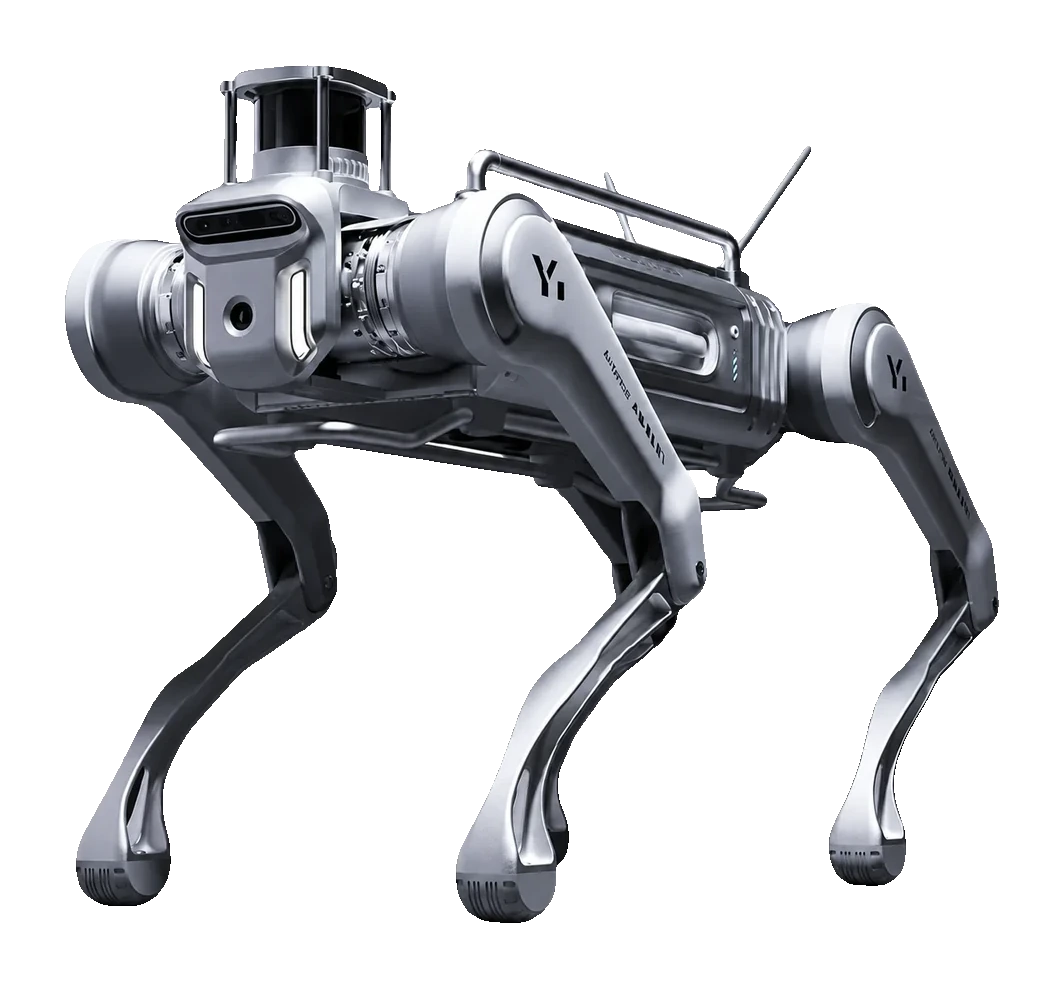
- MagicLab MagicDog Y1 - high-performance industrial quadruped for demanding inspection, security and logistics work, with a 45 kg payload capacity.
- Genisom M1 - a large rugged quadruped engineered for the toughest outdoor environments, including mining inspection and disaster response.
- MagicLab MagicDog - a compact, open-SDK quadruped suited to pilot projects and education, with a lower entry cost.
Talk to us about your duty cycle and we will match the platform to the runtime you actually need.
Sources: KAIST, via The AI Insider; Nature.